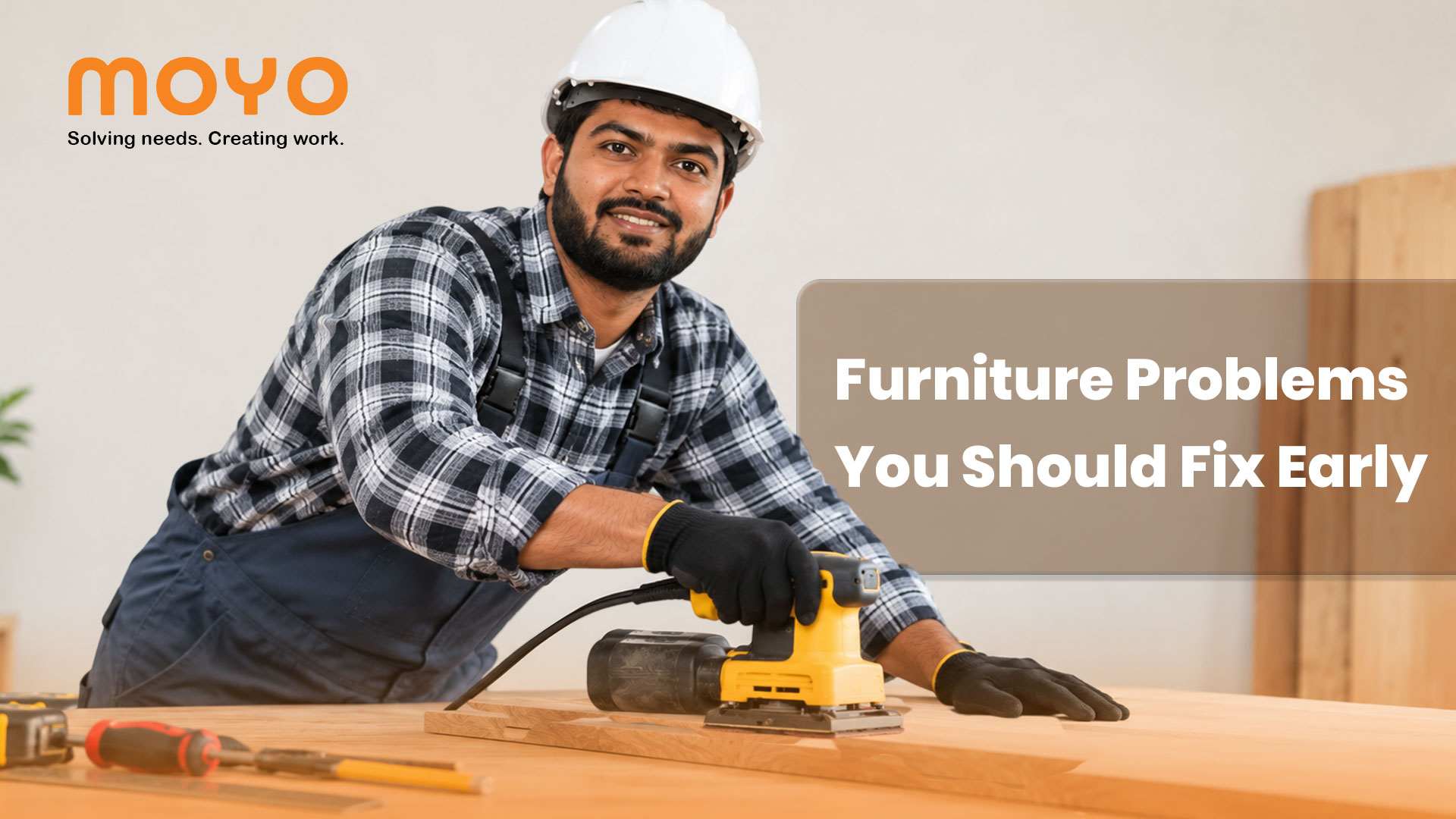
Common Furniture Problems You Should Fix Before They Get Worse
Small furniture problems can quickly turn into expensive repairs if ignored. From wobbly chairs and loose joints to damaged surfaces, learn which issues need attention before they get worse.
Moyo Team
Official Blog
That little unsteady chair in the corner can be viewed as a minor inconvenience. You just sit on it carefully and continue with whatever you were doing. However, what happens if that slight instability is a red flag? Most issues associated with furniture begin as minor nuisances but end up becoming very expensive if ignored for too long.
If your chair's legs are loose, the drawers won't move, the wood in the furniture has cracks, or the shelves are beginning to sag, then these problems are not serious at first glance. Nevertheless, by using it repeatedly, these issues become more complicated as you place added strain on other parts of the furniture, getting them serviced by the professionals on time can be a smart decision
But here's the positive side of it: you don’t have to be an expert in furniture to identify these symptoms. Taking notice of how the piece of furniture feels, functions, and looks can alert you of any potential issues.
Whether it is the dining chair, wardrobe, study table, cabinet, or even bookshelf, identifying these issues early can save you from having to spend extra money and avoiding accidents. In this article, we will discuss some seven major furniture problems that require immediate fixing and see how not fixing them might lead you into deeper trouble.
Wobbly Chairs and Tables: More Than a Minor Irritation
Have you ever sat on a chair and noticed that it wobbles slightly under your body weight? While this might seem to be no big deal, a "slight wobble" is something that needs consideration because what seems small can become serious.
What Causes the Wobble?
Some of the possible causes of a wobble include:
Loose screws/bolts: Normal usage can cause loosening of screws/bolts over time.
Uneven legs: Even a small difference in leg lengths can cause furniture to wobble.
Damaged joints: Constant movement can affect how well the different parts of the furniture fit together.
Uneven floors: In some cases, it is not the furniture that is wobbly; it is the floor beneath it.
Why Fix It Early?
The movement will put additional strain on the joints and fasteners, and after some time, it will deteriorate the condition of the furniture and make it harder to be fixed.
In the case of chairs, the danger is even bigger, as the furniture might suddenly wobble due to the person sitting or standing on it. There is also a chance that the table will become unstable and will not bear any loads.
A Tip You Must Follow
If your furniture tends to rock, creak too much, move or does not feel stable anymore, then do not delay the fixing process. Look at the joints and fasteners and fix the issue. Some effort right now will save you a lot of trouble later on. Book furniture services on Moyo to get it done fast.
Loose Joints That Can Make Furniture Unstable
Furniture joints tend to be overlooked because they are usually hidden. However, when your furniture begins to feel wobbly or loose, this could indicate a deterioration of your furniture joints. It is often the creaks or slight movements that will give you an indication that there is an issue with your furniture.
How Do Furniture Joints Become Loose?
Due to the fact that joints are constantly being subjected to everyday wear and tear, they begin to loosen. The reasons why this happens include the following:
Movement: This occurs due to everyday activity such as sitting, moving, opening, or closing.
Loose fixtures: This includes screws, bolts, and fittings that loosen.
Excessive weight: When too much weight is placed on furniture.
Changes in moisture and temperature levels: Due to wood expansion and contraction.
Signs You Shouldn't Ignore
Look out for subtle signs like:
Moving of a chair or table due to application of force.
Strange squeaking or clicking noise.
Gaps forming at the connecting point of wooden components.
Items which don’t feel tightly fastened anymore.
Why Early Repair Matters
A loose joint never heals itself. Any further use will only cause additional strain on the neighboring joints and may transform a minor repair into a more complicated situation.
Should tightening not help in fixing the problem, refrain from trying to fix the furniture by force. It is better for a professional to determine the kind of repair your joint requires – whether glue, new parts, or something else.
The takeaway: Whenever you notice that your furniture isn’t as tight and stable as it used to be, take it as a red flag, not an acceptable development.
Cracks and Splits in Wooden Furniture
An even small crack in the wooden chair or table may be tempting to neglect if the furniture continues looking perfect despite all those imperfections. However, cracks may sometimes not be only an aesthetic problem but also a factor influencing the structure and durability of the furniture depending on their location.
Causes of Cracks
Wood is sensitive to the environment, and common causes include:
Moisture: As the wood expands and contracts with moisture, it may end up with cracks in it.
Weight: Too much weight on weakened areas results in cracks.
Age: Old pieces of furniture tend to develop cracks due to the gradual weakening of materials.
Impact: Impact may result in cracks that will grow bigger with time.
Which Cracks Should Be Inspected?
All fine lines on the furniture do not mean that you need repairs. Yet, you should be more careful when:
The crack gets larger in size.
It is located near the legs, joints, or support parts.
The furniture bends near the crack.
Splitting happens along the wood grain.
Do Not Let It Get Worse
Repeated use of furniture with cracks may put an extra load on the crack area. What may look like a small crack may become challenging to repair later.
Surface cracks may be fixed with wood repair techniques. Yet, structural cracks must be inspected by professionals with knowledge in repairing furniture. An easy guideline: Any crack that impacts the ability of the furniture to bear weight is not "just a scratch."
Sticking Drawers and Misaligned Cabinet Doors
The drawer that needs an additional pull or the cabinet door that is unable to shut itself may be perceived as a minor annoyance at home. However, any problems with the functioning of furniture are usually indicative of some issues beneath its surface.
What’s Causing the Problem?
The following could be some factors:
Loose or worn hinges: The hinges are likely to move or wear off from repeated usage.
Malfunctioning tracks: The tracks can be bent or misaligned due to dirt or misuse.
Swollen wood: Increased humidity levels may lead to swelling of wooden surfaces.
Overloaded drawers: Overburdening the drawers causes misalignment of the tracks.
Signs That It Is Time to Take Action
Don't keep trying to open a drawer or cabinet door when you see:
Scraping or grinding noise.
Increasing difficulty opening a drawer.
Doors that are out of line.
Gaps developing between cabinets.
Loose hinges or handles.
Why Ignoring It Can Backfire
Furniture forcing can end up damaging the tracks, hinges, handles, or even the wooden structure itself. What used to be an easy fix can become a situation where replacement parts are needed.
First check if there is anything blocking the furniture from working smoothly. Then try tightening any loose parts you can find. If it does not help, get the furniture inspected, which will be a better course of action than forcing it.
Just a reminder: furniture is supposed to make your life easier, not a hassle. And it's better to solve alignment problems while they are small.
Loose Hinges, Handles, and Other Hardware
At times, the tiny furniture components are the most troublesome in day-to-day activities. The furniture handle which is constantly loosening itself, or the hinge causing the doors to sag will seem like insignificant things to consider. Yet, these small components are very significant when it comes to the overall functionality of furniture.
Small Parts, Big Effect
The hardware may come loose due to wear and tear with time. Be aware of:
Loosened handles and knobs: The repeated pulling will loosen up the screws.
Sagging hinges: Worn-out or loose hinges will prevent the doors from properly closing.
Missing screws: One missing screw will affect the positioning of the component.
Worn fittings: The bent hardware will not be able to serve its function anymore.
Why Should You Fix Them Early?
Leaving this type of problem unattended puts extra stress on other components of the furniture. For instance, loose cabinet hinges will add extra weight to one side of the door and might lead to damage to the area where the piece is mounted. A loose handle will come off, leaving behind a large hole.
How Can You Solve It?
Simple solutions include determining whether the screws and hardware can be properly tightened without causing any further problems. It is important not to continue to tighten screws that no longer grip the surface; this can be a sign of damaged material.
If the hardware is broken, bent or continuously loosens itself, you should consider either replacing the component or getting professional help with your furniture.
You should never neglect small things like screws, hinges, and handles that keep your furniture together.
Sagging Shelves and Bent Furniture Parts
Have you ever seen your bookshelf start to sag in the middle or the shelf of your cabinet bowing under the load of your possessions? It’s tempting to say, “I’ve been seeing that for months now, so it should be alright.” However, sagging often indicates that the furniture is struggling to carry its load.
What Causes Furniture to Start Sagging?
There are several reasons why this happens:
Excessive weight: Books, appliances, dishware, and other objects may exert a continuous strain on the shelf.
Worn out material: Some furniture becomes weaker over time due to frequent usage.
Lack of support: Large shelves lacking brackets and other supports are prone to bending.
Humid conditions: Excessive moisture causes damage to certain types of wood.
Signs that You Should Look for
You should be concerned about:
The noticeable bending of the shelf in its center.
Discrepancies between doors and drawers alignment.
The formation of cracks around support points.
Unusual noises from shelves while they are loaded normally.
Why Should You Repair It Early?
The slightly bent shelf can keep bending until it will not be able to sustain its load anymore. The worst scenario is that the shelf will break down abruptly, ruining your things and possibly injuring someone standing close.
You should start with decreasing the weight and inspecting the support system. If there is a bent shelf or damages in the support system, you should repair it.
Scratched, Chipped, or Peeling Surfaces That Need Attention
However, not all furniture defects are structural in nature. In some cases, the red flag will be visible on the surface in the form of deep scratches, chipped corners, peeling laminate, or cracking finishes. Although superficial flaws are generally of no consequence, surface problems should not necessarily be considered purely aesthetic in nature.
When Surface Damage Matters
Pay special attention to surface damage that:
Exposes the core material: It makes furniture more prone to moisture and wear-and-tear.
Spreads progressively: Peeling laminate and veneer may slowly come off a larger surface area.
Forms sharp edges: Chipped pieces and splinters present a potential safety hazard.
Affects joints and corners: It may indicate regular impact or stress in those areas.
Why Repair It Early?
As soon as there is any damage to the finish, the constant use, cleaning, and exposure to water will aggravate it even more. This means that a small chip will grow into a large area peeled off, and the exposed wood will get stained or swollen by water getting under it.
What Should You Do?
In case of small scratches, there might be some products to use as touch-ups. But if you see the peeling laminate, the loose veneer, chipped area, or splinters, you will need something else. You should never try to fix it just by painting it.
Final Thoughts
Usually, problems do not arise from nothing. They begin with such signs as a slight wobble, a loosened screw, a crack, or an unresponsive drawer. Such problems are perceived as minor ones, which is why people do not rush to solve them right away. However, such procrastination can have negative consequences and increase the cost of repairs in the future.
Nevertheless, the fact remains that there is no need to wait for your furniture to become unusable and unsuitable for use. You should pay attention to any unusual movements, sounds, cracks, sags, or changes in the functionality of doors and drawers. Early repair of such signs can help to protect your furniture from problems, avoid unnecessary accidents, and prolong the life span of your items. A chair you like, a wooden table, or a cabinet used regularly all require some maintenance and care from you. It is essential to react immediately to what your furniture tells you.
Frequently Asked Questions
Share this article